Federal Polytechnic Bauchi to introduce six ODFeL programmes in 2026/2027
By Maisaje Wakili
Federal Polytechnic Bauchi is set to introduce Open, Distance and Flexible e-Learning (ODFeL) in six programmes, including Mass Communication and Business Administration, for the 2026/2027 academic session.
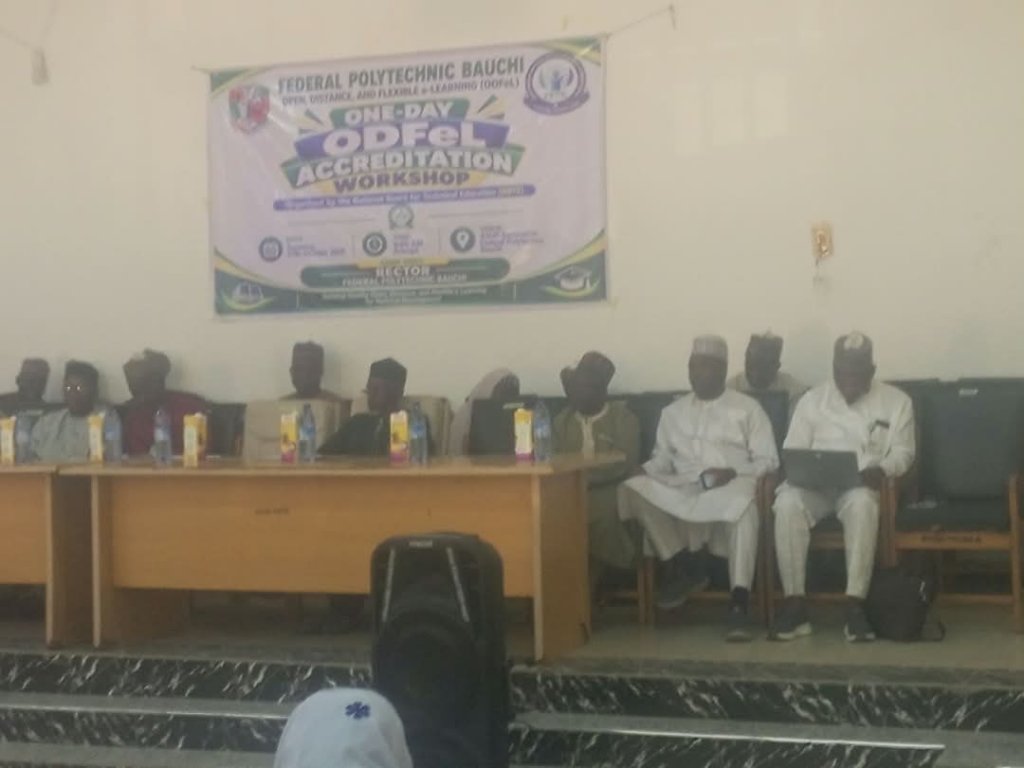
The Deputy Rector of the institution, Dr. Usman Yusuf Dutse, who represented the Rector at the opening of a three-day training workshop on ODFeL at the Polytechnic, said the initiative was designed to expand access to education through technology-enabled learning.
He explained that the programme would enable students to acquire knowledge remotely through internet-based platforms without the need for regular physical contact with lecturers in traditional classrooms.
Dr. Yusuf Dutse added that the initiative would provide educational opportunities for people living far from the institution, as well as those with family responsibilities and demanding work schedules, particularly women and business operators.
In his remarks, the Executive Secretary of the National Board for Technical Education (NBTE), Professor Idris M. Bugaje, commended the Polytechnic’s management for embracing the initiative, describing it as a demonstration of the institution’s commitment to innovation, expanding access to Technical and Vocational Education and Training (TVET), and preparing learners for the evolving demands of the labour market.
Represented by the NBTE Director for the North-East, Engineer Abba Mohammed, Professor Bugaje said the transformation of TVET required flexible, inclusive and technology driven approaches to teaching and learning.
He noted that ODFeL offered opportunities to widen access to education, promote lifelong learning and enable people from different backgrounds to acquire relevant skills and qualifications regardless of their geographical locations or personal circumstances.
The Executive Secretary stressed that the success of the initiative at Federal Polytechnic Bauchi would largely depend on the capacity and commitment of its staff.
He explained that academic staff needed to develop the skills required to design engaging online courses, facilitate virtual learning and assess students effectively, while information and communication technology personnel, instructional designers and quality assurance officers must collaborate to ensure reliable digital platforms, accessible learning materials and compliance with NBTE standards.
Professor Bugaje said the NBTE recognised ODFeL as an important pathway to expanding access to quality technical and vocational education, adding that its policy framework, standards and guidelines provided direction for institutional readiness, course development, student support, assessment and quality assurance.
He urged the Polytechnic to explore emerging technologies, including learning management systems, artificial intelligence, simulation technologies and learning analytics, to improve teaching and learning outcomes.
However, he cautioned that the institution must address potential challenges relating to digital literacy, internet connectivity, data protection, cybersecurity and the responsible use of emerging technologies.
The Executive Secretary further urged participants to translate the knowledge gained during the workshop into practical institutional improvements.
He called on the Polytechnic’s management to develop a comprehensive implementation plan outlining priority programmes, assessing institutional readiness, identifying staff training and infrastructure needs, strengthening student support services and establishing measurable performance targets.
Professor Bugaje also advised the institution to sustain the initiative through continuous staff development, collaboration among departments and regular monitoring of programme quality and student outcomes.
He emphasised that all proposed ODFeL programmes must satisfy the applicable NBTE approval and quality assurance requirements.